
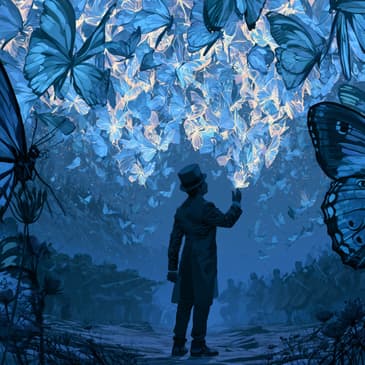
In this episode, Sleepy, we wander into the strange workshop of theatre itself. The table readings, the shoes, the frightened directors, the actors holding scripts like shields, the sacred line about saddling the king’s horses. I remember rehearsal rooms, wild-horse masculinity, Shakespeare chairs turned the wrong way, and the old ache of feeling like the dork in an eighties high school movie.
Then, because this is what happens, we drift north through Sweden with Mr. Green Branch and the Butterfly Orchestra, a bitter larva, a van full of jazz musicians, cold morning venues, moose hunters who cannot be reached, children storming the stage, and one parent trying to save everyone from dangerous jazz.
A sleepy, funny, introspective journey through acting, fear, touring, abandoned scripts, old theatres, and the small strange truth that sometimes a larva just has to become a butterfly. Or not. What happens, happens. May you fall asleep somewhere between the rehearsal room and the moose forest, and have a peaceful night.
Sleep Tight!
More about Henrik, click here: https://linktr.ee/Henrikstahl
Hosted on Acast. See acast.com/privacy for more information.
[00:00:00] Hi and welcome to Fall asleep with Henrik. I'm Henrik and you're sleepy and it is what it is. What happens, happens and right now there's nothing we can do. Let's go.
[00:00:23] Hi sleepy. Hi and welcome back to my humble abode. I'm Henrik and I will speak for about an hour-ish with no intent, nothing thought out in advance.
[00:01:00] I will just speak and whatever happens, happens. This is the way the story goes each and every episode and nothing much will really come out of it, I guess. This is non-content in a way. You don't have to listen, you can just put me on in the background or you can listen quite actively if you want to.
[00:01:30] I'm here for your non-entertainment, but I'm not here to bore you. That's an important distinction, I think. I'm not here to bore you out of your mind so that you fall asleep from the pure dullness of it.
[00:01:50] Because I am by nature an entertainer, I think. I think my calling in life is to make people enjoy themselves. So the key ingredient in this is that I haven't prepared and that's why it sometimes becomes soothing, I guess.
[00:02:16] Because I don't plan ahead. I haven't thought out anything. I'm not in my chamber with my pencil writing ideas on napkins. I haven't workshopped anything, although that would be cool too, I guess.
[00:02:40] I have these memories from throughout my career in television mostly and mainly, but also in theatre where this happens. This occurs when a few of us, directors, scriptwriters, actors, performers, you name it. We go on a trip, maybe. It could be a day or a few days and we workshop stuff.
[00:03:09] We workshop content, the material that we're going to perform. And that's always very fun and sometimes very frustrating. I was in this play once. Well, I should, if you are new sleepy, then maybe I should mention that my prime,
[00:03:36] my major occupation in life is actor. I'm an actor. Although I don't act so much anymore because all of my time is consumed by this questionable occupation, talking into a microphone, putting people to sleep. But anyway, that's my training. That's how I spent most of my days up until now. And I was in this play once.
[00:04:06] I'm not trying to say where and when because that will maybe give out and point at certain people or organizations. And I don't want to trash talk anyone. But this was kind of an example of where workshopping of sorts becomes, yeah, not a success.
[00:04:35] So the thing with this play, I was hired as an actor in this play. And the concept of it was that we were going to develop the play as we rehearsed it. So when we first met, we were a few actors and a first-time director.
[00:04:58] And we had this meeting, this startup meeting, and then we started workshopping. Oh my God, I don't know how to go about this without exposing the people involved. It wasn't a disaster. Actually, I think the final result was, yeah, it was good, you know.
[00:05:31] The thing that we struggled with was when you don't have anything and you have a first-time director that is insecure and also have struggles a lot with bad self-esteem, then this open workshop environment can very, very fast translate into this,
[00:05:56] transform into this kind of scared environment when everything an actor says becomes a threat, you know. And that's what, that is what happened. So this director was really scared and they felt kind of like they didn't contribute anything.
[00:06:21] Overall, being an actor, I think, is, from my point of view anyway, the worst thing about being an actor, and now I'm talking about a stage actor, is that you dwell so much on the specific material and in the same way you dwell,
[00:06:48] I think, too much on what type of a person you are, how good of an actor you are, what methodology you were using for this and that. And we don't really have a common kind of nominator. Can you say that? Common nominator. As far as acting methodology goes, when we rehearse,
[00:07:14] we come from like different schools and different cultures and environments and previous jobs. So we carry that with us and we meet. And the first few weeks are always this kind of an explosion in different types of actors with different types of acting methods meet. And we're going to find this common nominator that creates this specific piece of art that a play is.
[00:07:43] And that's always a very scared and nervous and tumultuous moment. A prolonged moment. So in most scenarios, when actors meet and start to rehearse a play, there's this reading of the play initially where everyone involved, including the people working not on stage but behind the stage
[00:08:15] or in the production in other senses, everyone is gathered around a table reading the play and everyone has a lot of fun. Everyone is happy. Everyone thinks that this is a good idea. And we cry when we read the material. Out of the sheer impact of it, everyone praises the play.
[00:08:42] And then maybe we have, if this is a very, what do you say, high-end production, then there's of course a lot of artistic value already being put into the production itself. Like costume and makeup and props and decor. Stuff like that. And the director, of course, has a lot of thoughts.
[00:09:10] This wasn't the case with our workshop production that I mentioned previously. But it's usually the case when the actor arrives, so to speak, into the production in the process. There's been this already a process
[00:09:36] with the other artistic responsibilities in the production. So then as an actor, you're very happy, you're very excited, you meet your colleagues, maybe you meet a few new people for the first time, you're nervous, you're happy, you're excited really. And then you run into all these visions. And the visions are like, yeah, we think about this
[00:10:05] in terms of costume for you. And you go to tryouts and you measure and you do color samples and you're almost always disappointed because in your mind, when you read the play, you had this totally different viewpoint. But you can't really bring that. Some actors do anyway. And then there's this discussion and this debate
[00:10:31] and a lot of actors have a lot of opinions on, for instance, shoes. Like shoes, what shoes should the character wear? Because it brings so much to the posture and the movement of a character. And yeah, I can accept that. But I have never said anything in terms of, no, I don't like this. I don't like it. I'm just letting people put stuff on me, you know.
[00:11:01] But I'm almost always disappointed because in my mind, things look cooler and different in all sorts of ways. And then maybe you meet the sonographer and they show you like what they have in mind in terms of what the stage will look like. And again, for me at least, it's always, almost always a disappointment
[00:11:30] because in my mind, it looked different. And as an actor, I can't really, and I'm not saying this to complain because I know that this is a profession and I don't claim to be a good sonographer or a costume designer or anything like that. It's just that when you read something for the first time, you have like, I paint this whole picture of what it's going to be.
[00:11:58] And then you meet like reality. That's always kind of a heartbreaking moment for me whenever I've been engaged in plays or in cinema for that matter or in TV. It's like, why should I do, oh my God, I thought that I really could do this character dressed in this and that. But then again, they've thought different. Okay.
[00:12:29] So I've kind of early this episode reached this moment when I don't find the words for whatever I'm talking about. So if you're new here, I'm Swedish. English is my second language. If there even is such a thing as a second language, we start learning English way, way early in Sweden and we're kind of good at it.
[00:12:57] But we feel very self-conscious and bad about it internationally speaking. We're not like, there are so many people speaking English in the world and some, most of them, the people speaking English do it with confidence, you know, whether or not you're a fluid English speaker.
[00:13:25] You do it with confidence because it's a, you can, you can really approach this language from any angle and you will be understood. but for some reason, Swedes have like this sense of us being these dorky, yeah, the closest I can come to comparison is if you think about some old high school movie from the 80s
[00:13:54] when there's this dork, this nerd and he has a calculator in his breast pocket and he, he, he has thick glasses glasses and a nerdy hairstyle and he's not like the jocks and the pretty girls and he's looking at a girl and his friend says, don't even think about it, she's way out of your league and of course it will end up, the whole thing
[00:14:24] will end up when she's, she's really like fragile and, and, and in a very exposed position and he will come swooshing in, rescuing her and she will see the true him, you know. Anyway, so that's, I think, in the international arena, in the arena of English speakers in the world, Swedes tend to see themselves as the dorks in, in, in a 1980s
[00:14:53] high school film and, not in a good way, not in the sense eventually this will all be about me and I will be the hero, not in that way. We're the friends, we're the dork's friend, you know, that continues being a dork way after. The, the original goat dork rides, gets away on his lawn mover with a
[00:15:22] pretty girl cling to his back, like in the ending of the classic high school film, Can't Buy Me Love from 1990, 1980 something. Anyway, so, when you have, when you've had the reading and you have had the initial, mostly like, information meetings with the other artistic fields
[00:15:52] that build up the play, the production, and of course the director, then you start the rehearsal and that's always kind of a nightmare. I don't like to rehearse. I think it's boring and it's, it's a scary, scary process and you, you,
[00:16:21] you stay with this process for six to eight weeks when you're doing a stage play and during this time you feel bad almost all of the time. I'm speaking from my own perspective now, by the way, because some actors really like it during rehearsal, they feel safe, they feel, well, some actors say that they value the process of rehearsing something, so they work
[00:16:50] very meticulously, slowly, with great care, you know, but sometimes I think that's all bullshit because it's really just a cover-up for fear. I think as an actor I am an all-in kind of person. my dream scenario would be to rehearse like the whole play over and over and over again without
[00:17:19] stopping and just analyzing and just don't get me wrong, I really enjoy analyzing as being shown in real time by me doing this podcast. It's just when we do it in the art form of acting in theater, it's almost always a lot of other stuff that comes creeping in, you know,
[00:17:50] like hierarchical, oh I have such an issue with that word, hierarchy, hierarchy, how do you say it, in Sweden we say hierarchy, hierarchy, yeah that's, yeah okay, hierarchy, hierarchy, yeah that's probably it, hierarchical stuff comes creeping in, a lot of fear as I
[00:18:20] mentioned and a lot of covered up fear, like if you paint fear in a bright color or like in a gradient of some sort, then you can camouflage it and it will look like, you know, hard work or deep analysis and slowly taking care of the
[00:18:49] character and for me that's just hiding. I can't really discuss this with other actors because there is as many perspectives on this as there is actors I think but I think so many times I've been in situations where actors, fellow actors just refuse to let go of the script like they carry it around them
[00:19:19] like a shield and for me that's just fear, you know, so you haven't learned your lines, okay, I get it, I get it, you have like true technical issues with remembering lines, I realize that we do this in different ways, so okay, fine, then just be honest, I haven't learned and I'm really scared, you know,
[00:19:50] I'm afraid to say the wrong things but for me as an, I'm that type of an all-in actor kind of type that I learn everything the first week and then I just, I just do it and I do a lot of mistakes and I work really fast and I run really fast into stuff and sometimes that's from the
[00:20:20] director's perspective, that's a blessing, like initially because then there's a lot to work with like really fast, really early in the process but then I become this boring because I'm not in line with the other actors so that's one of the major criticism I have had to endure during my acting years
[00:20:49] is that I am too fast, not fast as in good fast because there's really no such thing in acting really or in any art form I guess it's just that I am by nature sort of a person that builds worlds in my mind really like all of the time and I enter the workplace with all of this
[00:21:17] and I'm really suck at just you know pressing all that down just for the sake of like a methodology so on one hand we have an actor that is well maybe he's afraid to really
[00:21:47] let go maybe he's afraid to lose control like it's not a bad thing it's a human thing you know so he goes there and he has this he's clinging to the script like it's the bible or it's a shield or whatever he doesn't look at the other actors he's just staring down and he says you have to respect my process I'm really trying to understand the words and then it becomes laughable to me because what are you trying to
[00:22:17] understand the only thing that you're going to say here is that your majesty I saddled the horses you know that's your line why don't you just come in here and you say that to me and then we'll see what happens you know that's that's kind of my and I really think I'm sorry for I don't want you to think of me as a as a bragging obscene kind of
[00:22:46] because I am apparently an unemployed actor and I've been so for kind of a lot of years now because I'm doing this so I don't really know if I have a say in the matter anymore but yeah I think that's a bad way to approach it just let go of the script for instance like try to really learn your lines before you enter the production enter the rehearsal
[00:23:17] I mean just please that's like but almost no actors do that it's sometimes it's like it's frowned upon because you are not supposed to do what I do you're not supposed to make up your mind what you're going to tell before you've met the director and the rest of the rehearsal and in a way I can understand that and I can respect
[00:23:47] that because we need to tell the same story and I think of any if any risks are involved on my behalf it's that I am done too soon you know and then it becomes sort of a limping project worst case scenario there's this one guy he's doing his own show and the rest of the
[00:24:17] actors are doing there and I think that's one of the things that I've endured in terms of criticism is that I don't really I have decided really what I'm going to do and then I come in and more more more us that
[00:24:49] creates the worlds you know because we love them it's a surprise to me that so few actors really enjoys creating worlds most of the actors I know really are just people that are I guess they are fans of the work process like it's the work process itself
[00:25:18] is the reward and I've never felt that maybe that makes me not so much of an actor I don't know I respect the process I respect the craft but I don't really care so much about it really at the end of it the audience will not see the craft the audience will
[00:25:48] not see in a good play the audience will not see exactly what you as an actor struggled with in order to deliver these lines your majesty I've saddled the horses they would just see a servant coming in telling his king that he saddled the king's horses that's I mean that's what we aim for isn't it so I don't really care
[00:26:18] about all the process and all the analysis because sometimes it has the habit of following the actor into the actual finished production finished play I was at this awful performance this was a few years ago and I keep coming back to it and I talk about it a lot it was on this very famous Swedish theater in Stockholm
[00:26:48] and it's a huge and old theater building hundreds of years old and you know it's culture it's tradition it's it's the king's theater you know so it's extra fine and it almost never is I haven't you know I'm not a frequent visitor so I can't really say that there's something
[00:27:17] I just don't like it when actors treat themselves with so high dignity that they forget that they're there to present something that they don't really have true control over if you cling to it like you cling to a script throughout the rehearsal period if you say I understand everything about this and you as an audience you maybe you don't have like if you're truly
[00:27:47] truly elite you will understand what I do otherwise you will just be amiss you know and I I see that throughout so many performances and in this particular case this was I can't actually remember the production it was a Shakespeare play and the whole thing began there was this
[00:28:18] screen some see-through fabric that was covering like a curtain so you could see men behind this see-through screen and the curtain rose and we could see that there was like 14 men with
[00:28:47] white shirts and black pants and black shiny shoes sitting with opposite turned chairs like you lean your chest against the back of the chair so they turned the chair all the way around like this very cool way of using a chair you don't use it like you're supposed to you just flip it around and then suddenly you're a rebel you know you know so much more than everyone else
[00:29:17] and they were turned with their backs towards us the audience and I immediately I couldn't help myself I just said no you know because I just knew what this was going to be this was going to be this self-righteous display of what the production perceived as masculinity you know
[00:29:48] it's something with shirts that are open a bit you know some chest hairs visible and they're kind of wrinkled and these stringent black pants and shiny shoes that are just this is it's such an ick for me I I just don't really I just hate it feel this furious anger whenever I see a
[00:30:18] man showing up with his buttoned up shirt and his wild whore's eyes I can't come up with a better analogy than just well it's not an analogy I don't know what it is if you compare it's whore's eyes it's like this is wild uncontrollable look
[00:30:47] and messy wild whore's hair and it just looks out into the audience in this case the men had their backs turned on us and I was already convinced that this will suck this will just suck I can't remember the Shakespeare what Shakespeare production this was maybe that's just as good because it's yeah it wasn't it wasn't a good thing and then at
[00:31:18] some cue every one of the men flipped their chairs around I mean and themselves so that they were facing us and then in unison they just let out this manly sound you know that was the beginning oh god I'm sorry for laughing this is and if you're not in this field maybe this just comes off as elogistic
[00:31:48] rambling but then again you're not supposed to listen you you can fall asleep to this and maybe this is elogistic rambling it's just
[00:32:38] just said oh like really cool and I don't really know if there even was a segue into whatever play that it would turn out to be I can't remember I'm sorry sleepy I'm a bad storyteller in this sense that I don't really remember and even if I
[00:33:08] oftentimes actors are also I don't want to say it but I'm going to say it victims victims to like mostly it's a director that is insane you know that has illusions of grandeur or something or just this puberty based self-image
[00:33:37] that they need to you know paint the whole show with my year I was one I was I was working one year at this Royal Swedish theater in Stockholm I was scared all of the time I was scared because there were so many famous alpha males that worked there and
[00:34:06] of course I felt like this I get sometimes I get criticized in Swedish in Sweden for always playing the victim always playing drawing that particular victim card and maybe that's true the thing is I struggle a lot with that I automatically put myself there
[00:34:36] like I don't really matter don't people the cool people the cool kids don't really see me you know that's how I evolved that's how I became me and that's those things are not so easy to get rid of because I know that today I am I'm a grown piece of monkey and I am I have power you know I
[00:35:07] am I am someone you know I am not that dorky kid that no one notices I am this power person in a way and that it's very important I think to remember and to keep that in mind when playing the victim card but that doesn't mean that those feelings of obscureness go
[00:35:37] away like automatically I don't think they will ever leave me for me it's an important distinction between telling stories about abandonment and feeling left out being an outcast and actually leading people to believe that you are those are different things and I think it's an important distinction to make because
[00:36:07] a lot of people are truly always like painting themselves like victims and they keep doing it like throughout their lives so you had something terrible happening to you when you were a kid and you keep identifying with that like overall in total
[00:36:37] so then everything becomes proof of this evil world that don't get you and I feel that I totally feel like it's high school renewing itself over and over and over again the pretty girl doesn't want me cool kids doesn't see me you know all of that but at the same time I know that it's more nuanced than
[00:37:06] that and in all that matters that's all over for me I think it's an important inner distinction to make so that was my whole defense speech on why I always play the victim I'm not sure that I do but I do talk a lot about when I feel socially awkward left
[00:37:36] out and abandoned I do talk a lot about that I do think a lot about that as well so that workshopping thing weren't really going going on going on at the same time
[00:38:06] so there were a lot of feelings I've had so many not in just in this production but in every production really I have had so many arguments and crying conflicts running out slamming doors you know there's not so many other workplaces where this is like a normal occurrence
[00:38:37] it took me a few years to really accept that conflict is a part of rehearsing a play I was in this show once and the director and one of the actors one of my fellow actors didn't really got along they and I think it was like three
[00:39:07] days and then this actor told the director in this meeting that we had before starting rehearsal I don't feel that you really see me you know and the director was like what do you mean we were just three days into this what do you mean not see you and then there was this very trembling fragile silent moment and then my fellow actor just started crying and ran out and and I ran after and then there was immediate to this you
[00:39:37] know rupture why would we even what good did that do I mean sometimes people say that it's a fragile thing and it's necessary we need to be fragile because we are like creating stuff that comes if it's going to be real like true it needs to come from a
[00:40:07] place where when we are vulnerable and I agree with that I do and I'm not against the conflicts of sorts I'm not against the conflicts as you know I'm not against them it's just sometimes I wonder if it were to be more helpful if we had this deeper sense in all of us
[00:40:37] if we could share that as actors that this is just a play we're just going to do this as good as we can if it doesn't work then we'll do better next time you know because there will be a next time but we never think that it will be a next time maybe that's why we always are so stringent and fearful that
[00:41:08] if you do something that people don't like then you won't get hired again so I mean sometimes anyway but if we were all in agreement that this is not like this is not a sacred religious calling kind of thing this is a group of people playing make believe with years of training behind it so it's a noble art it's an art form
[00:41:38] and I really respect the art form itself but it's not more important than whatever the audience gets out of it and in the end we're just playing make believe so you don't have to really process and read the hell out of that line where you're going to go in and tell the king that you settled his horses you don't really need to understand like each and
[00:42:08] every singular event event that event that took you to this place where you go in and tell the king whatever if you're enjoyed by that do it you know but don't take it so seriously don't try to build something that's just for your own benefit for the with the
[00:42:37] sole intention of making yourself feel like a good actor you know so this was my lesson in good acting because I am indeed in a place where I can point fingers really I am you
[00:43:15] miss some of it I miss colleagues I don't have any colleagues sleepy I don't I really miss that I don't have like a sense of a shell around me where stuff are being taken care of without me taking care of it it's just me and
[00:43:45] also I have this girl named Julia who works for me now with my Swedish podcast so I have her and I'm really grateful that really changed a lot of what I do since my Swedish version of this podcast is my major livelihood but this thing I'm doing right here it's growing and I don't have Julia here it's just me
[00:44:15] and I really miss a roof over my head in that sense I would love for yeah I would really love for to get a call from my director telling me yeah let's work you know I don't really care the type of production you know as as I don't really care
[00:44:46] if it's a no at the moment I don't have a preference I used to have preferences and that's mainly why I quit acting a few years back and decided to just focus on my my voice and that was I have toured for 15 years maybe in like small theater groups with minor productions with
[00:45:17] extensive tour schedules you know playing this two man show in a 60 cities tour and that's fun it's fun because you really get close to people and you get to see a lot of different places and stuff but I was all through that arriving in small venues building the set yourself eating
[00:45:47] on you know half closed shabby local restaurants you know trying to find the local producer that have hired you in the first place but they were for some reason out hunting moose you know that's actually a true story I was I was I was doing this play
[00:46:15] it was just me I was I was the only actor then I had four musicians jazz musicians with me and we did a show for kids that was called which means Mr. Green Branch and the Butterfly Orchestra and the jazz musicians were the
[00:46:45] Butterfly Orchestra and I were Mr. Green Branch and Mr. Branch was a larva that had refused to turn into a butterfly because he was scared of the change and when he was a kid his mother turned into a butterfly and left him and his dad and his dad out of bitterness and also I guess alcoholism I didn't
[00:47:15] say that out loud because that was a child's play but that was my underlying thought his dad became a bitter alcoholic and died as a larva so Mr. Green Branch has decided to stay a larva like his dad but then there's this Butterfly Orchestra who comes and just torture him you know they play their happy music and they don't leave him alone
[00:47:45] and suddenly at the end he just transforms they force him more or less they push him into Butterflyness if there even is such a thing of course there is that's what Mr. Green Branch went through anyway so I was I wrote the thing my brother who was also a part of the musicians he wrote the music so and we
[00:48:15] I sang so it was a musical show and I played Mr. Green Branch and we had the set we built the set it was a very easy setup so we just put up a tent really and we had I think we had like 65 shows all over Sweden this was in 2007 and back then there were no I
[00:48:45] guess Facebook just entered the stage but there were no other social media MySpace I guess was something that existed but not in a sense that everyone was there so you couldn't really get in contact with people especially not old people and most of the local producers that have hired the show they were we were hired through this national
[00:49:14] organization that is like sort of an umbrella organization for all small stages and venues all throughout Sweden old places like old parks and old venues that maybe some of them a hundred years old or older at some of them we found old autographs from the 60s like the Beatles was here in 1968 or something so
[00:49:44] that was really cool cool old places old venues old stages would sometimes half you know half rotten you know decaying buildings being held up by old people who worked for no money just for their interest and passion so we learned a lot and it was a lot of fun but I was also
[00:50:16] besides being the lead and also the writer and the director I was also the tour manager so it was my job to stay in contact with all those like 60 plus old guys that produces locally and this was in the fall in Sweden and we had
[00:50:46] this moose hunt a legal like the only legal moose hunt the haunting of the mooses that's what goes on in Sweden every fall we haunt the mooses so that they
[00:51:22] could be contacted because they were lying in the woods somewhere with a rifle and couldn't be reached you know so there were so many times when we stood because we also drove ourselves in a little minivan provided to us by this local this national umbrella organization it's called the people's houses and
[00:51:53] it's an amazing organization because it really brings culture to every nook and cranny you know out in the very tall country that is Sweden so it was amazing to just see all these places but imagine coming to a place like 7 o'clock in the morning it's cold you're way up north way up
[00:52:23] north and you're outside this old building first of all you can't go through the gate because there's no one there to open it so I had this huge binder with all the telephone numbers to each and every one of these local producers so in the darkness I just fumble through the numbers and I just call and then there's no one answering and then
[00:52:53] I call the home number because people gave out their home numbers so I call the landline and then his wife the local producer's wife answered early in the morning like who is this hi your husband has hired us to come play for the eight children in the village can you keep put me in contact with him yeah but he's out he's been out for
[00:53:28] with the outside world except maybe the other hunters it's radio silence you can't you know so there was so many times when we just didn't get in so we just had to wait you know and of course there are no places where you can rest or have a coffee or anything you're just in like in the middle of nowhere and it was also cold I remember being cold and then we we had this sound setup that we
[00:53:58] brought ourselves and my brother he dropped this speaker on his foot when we were unloading the van and and I could just see how something in him broke except for the I mean besides the foot because the foot well maybe it broke a little but the pain you early morning and the harshness of it I could just see the little
[00:54:27] boy in him just you know looking up from whatever well we had dug for him with our senseless touring why are you doing this and at one time when playing for kids you know when doing a kids show you meet all sorts of audiences really kids don't have the polite sense
[00:54:57] of let's just sit here and let these guys do what they're here to do so when we were in venues when the stage weren't that high
[00:55:56] people
[00:57:27] jazz jazz music jazz music jazz jazz music and we so this particular parent thought that it was too loud so she ran up on stage and she just went over to the mixing board and she just started
[00:57:58] pulling levers and again my brother was there and he was like what are you doing at the same time he was playing guitar and this parent was just in this state of we need to protect the children and now before you run off and you say that of course you need to protect the children I we had like all sorts of
[00:58:27] sensors that told us that this is a safe sound environment but this parent was convinced that we were trying to harm the children in a way with loud jazz music but it was a
[00:58:59] and that's true I guess I keep the darkest things closest to my heart and I don't really know why maybe that makes my life worse in a way but there were a lot of beautiful moments for instance I was deeply in love with Nina my then after that to be partner for 17 years
[00:59:30] we had just fallen for each other so we had this endless phone conversations and that was amazing nothing had really started yet little did I know that we would have a child together and that we would have 17 amazing years together yeah so anyway sleepy
[01:00:00] the episode is over men that was a Swedish word for but the episode is over men I will be back next week same time and if you haven't fallen asleep yet you can listen to another one or just lay there in silence I hear that's good for you too you